

Attila the Hun (2012)
Lost to History
Please enjoy today’s public post. I hope you’ll consider joining with a paid subscription to see new posts every weekday.
Really a lot of the fun of doing historical fantasy is doing some of the research part. With the Huns, it’s problematic because many military history works barely touch on them. As they were nomadic, it’s not like we have a lot of remnants of their culture in archaeological town digs or anything. As well, they trafficked in and among other tribes of the Russian steppes like the Scythians, Alani and other Sarmatians. Not only traveled among, but intermarried as well, Attila himself having many wives, including among the Scythians.
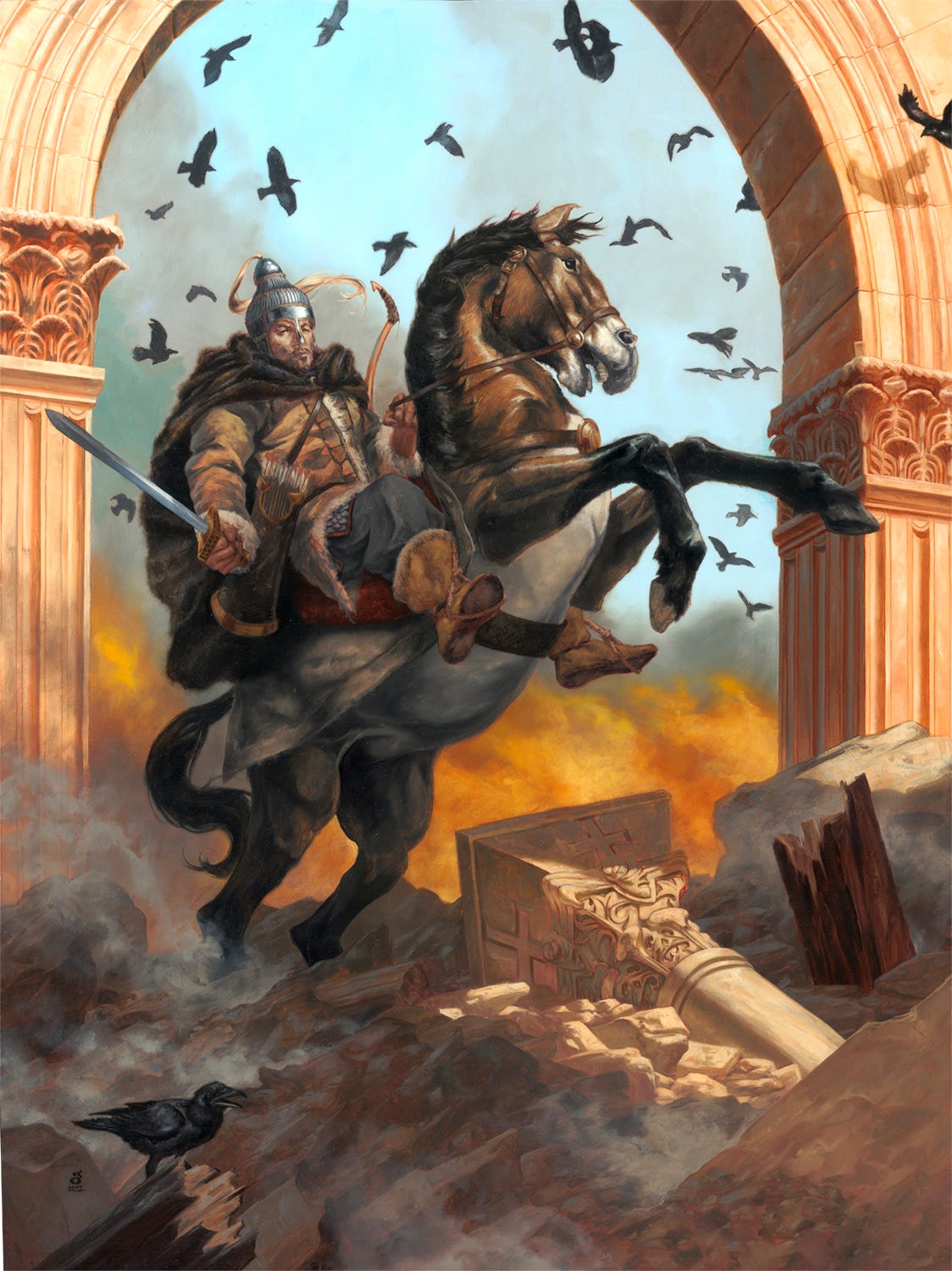
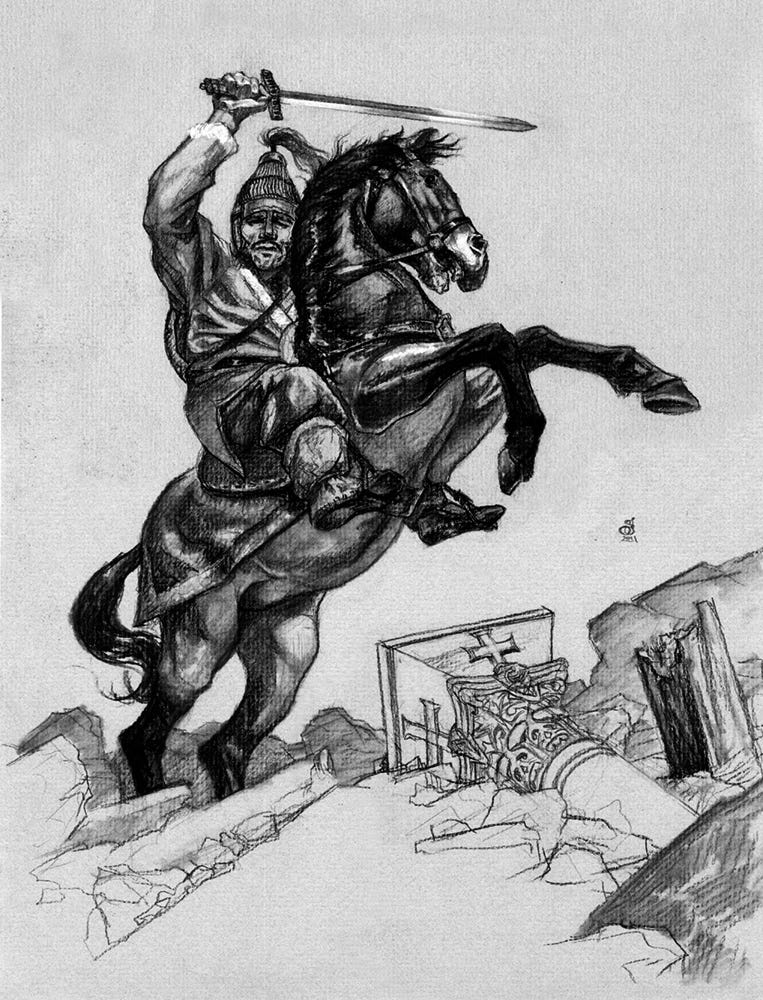
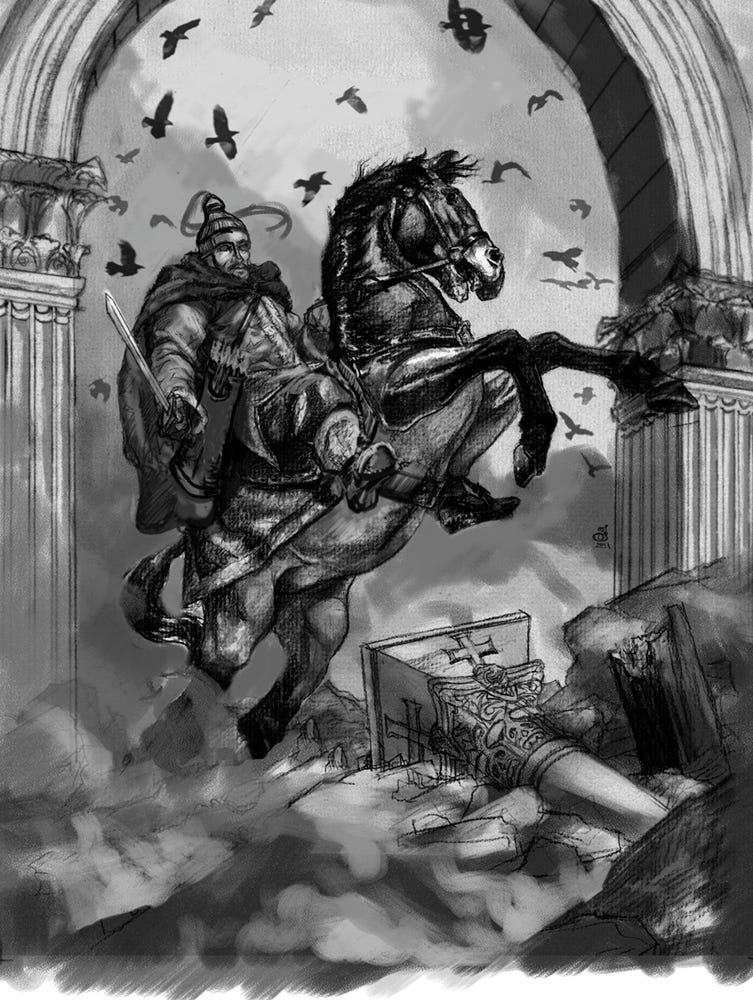
When doing more historical works, an illustrator runs into a problem. Within gaming and the like, it’s not like historical stuff necessarily pays any more than usual. But the prep-work for a historical piece is considerable, before one even begins thumbnailing. And it all depends of course on how detailed one wants to get. If this were National Geographic, it’d have a whole other caliber of research on top of this, but their budgets are bigger, too. The go-to for illustrators are Osprey Books’ Men at Arms series, many illustrated by the late Angus McBride. And yeah, they covered these groups, too. It’s decent, but I was finding info and small details slightly at odds with it through other research. When I did, I favored the research I had done. I took for granted the intermingling of cultures, the ransacking of enemies and so on, so there’s a hodgepodge of sources, some of which might be stretching it here and there. But then, this is also a fantasy illustration. The pose itself was requested to hearken back to David’s famous portrait of Napoleon, which dictated the overall mood.
Though a few ancient historians wrote about the Huns, I favored Priscus of Panium, who actually met Attila and wrote the only known first-hand account of him. It was a fascinating read, from which I learned about his inter-tribal polygamy, his hairstyle (which I would have loved to have portrayed—as it sounded like a bowl cut), also that he had a dignified quality about him (as opposed to a savage appearance), and dressed very simply, preferring a lack of ornamentation both on himself and his horse. Those last two points were critical for me, since the temptation is to lay it on. I supplemented this with other folks’ second-hand accounts.
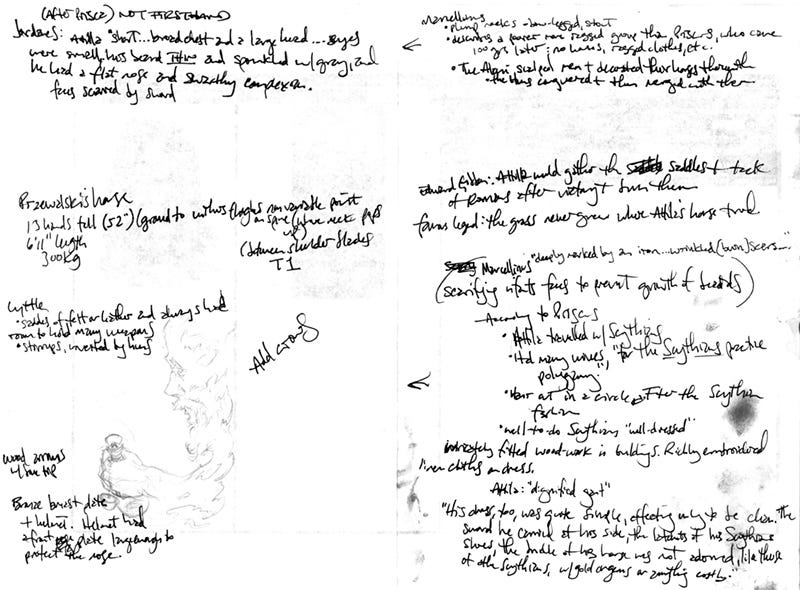
For his horse, I sought out some native breeds and settled on Przewalskis, which have lovely coloring and a slightly unusual shape. As Attila was known as, “The Scourge of God,” in his time for his army’s fierce combating and destruction, I placed him within the ruins of a church or cathedral of some kind. Crows added a bit more narrative and doom to the image.
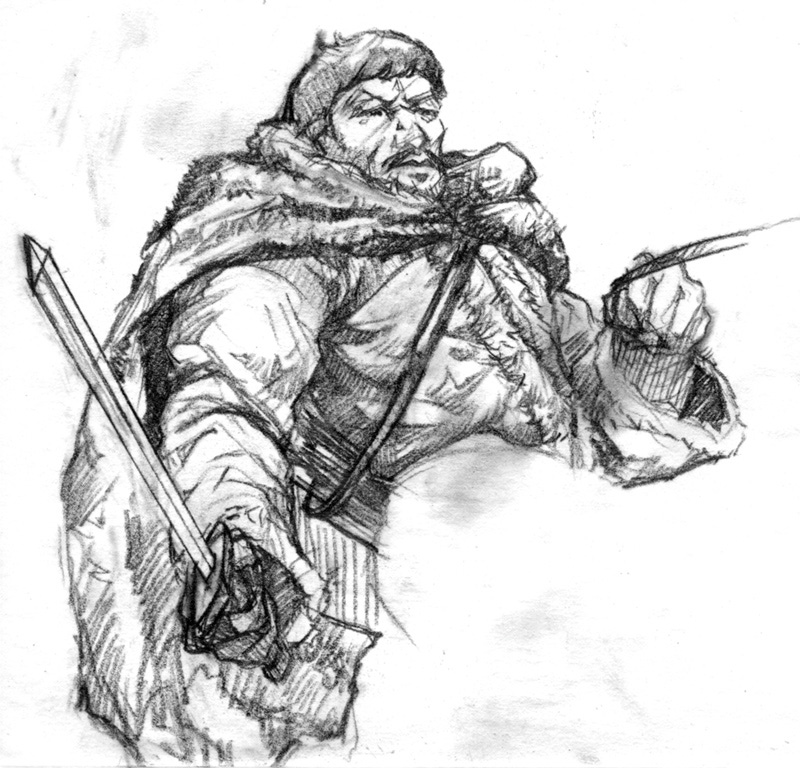
The image, were it to have seen print, might have had additional tweaks, including a figure among the rubble. I gave it to the publisher layered to give them some options, but the project disappeared and never saw the light of day, so I’m reverting back to my painted version here.
The thing with historical fantasy is you want to do some diligence in researching, but you’ve often got considerable budget and deadline constraints to worry about as well. And no matter what you do, real history buffs will come around and point out your errors. That’s a shame, too, since if I had my way I’d have done even more research than I did. As it stood, I ate through the budget so fast on this one, given the detail and all, that it became something of a labor of love by the end, out of pride for one’s work.