

Black Truffle Tomato | Red Currant Tomatoes (2013)
Simple But Transformative
Today’s post is part of a free preview of the daily post. Most daily posts will be for paid subscribers as we roll along. I hope you’ll consider joining with a paid subscription to see new posts every weekday.
2013 was a transformative year for me. I had begun a 3-year hiatus from Magic: the Gathering and did my last D&D illustrations through even now for 5th Edition. That summer I worked on a 4x6 foot painting and in between sessions on that work, began playing with still life painting again for the first time since maybe college.
For some of them, I would grab small leftover pieces of canvas—I keep a bunch of them primed in various colors. After priming, I sometimes take leftover paint on a palette after finishing a painting and mix it into a muddy color, then use it to tone the canvas, after which it sits until an opportunity comes to make use of it for a study or somesuch, as these are often small, standard-sized pieces.
I did a few of these early still lives just as a break, and a few like today’s I didn’t even bother showing anywhere since, let’s face it, they aren’t much!
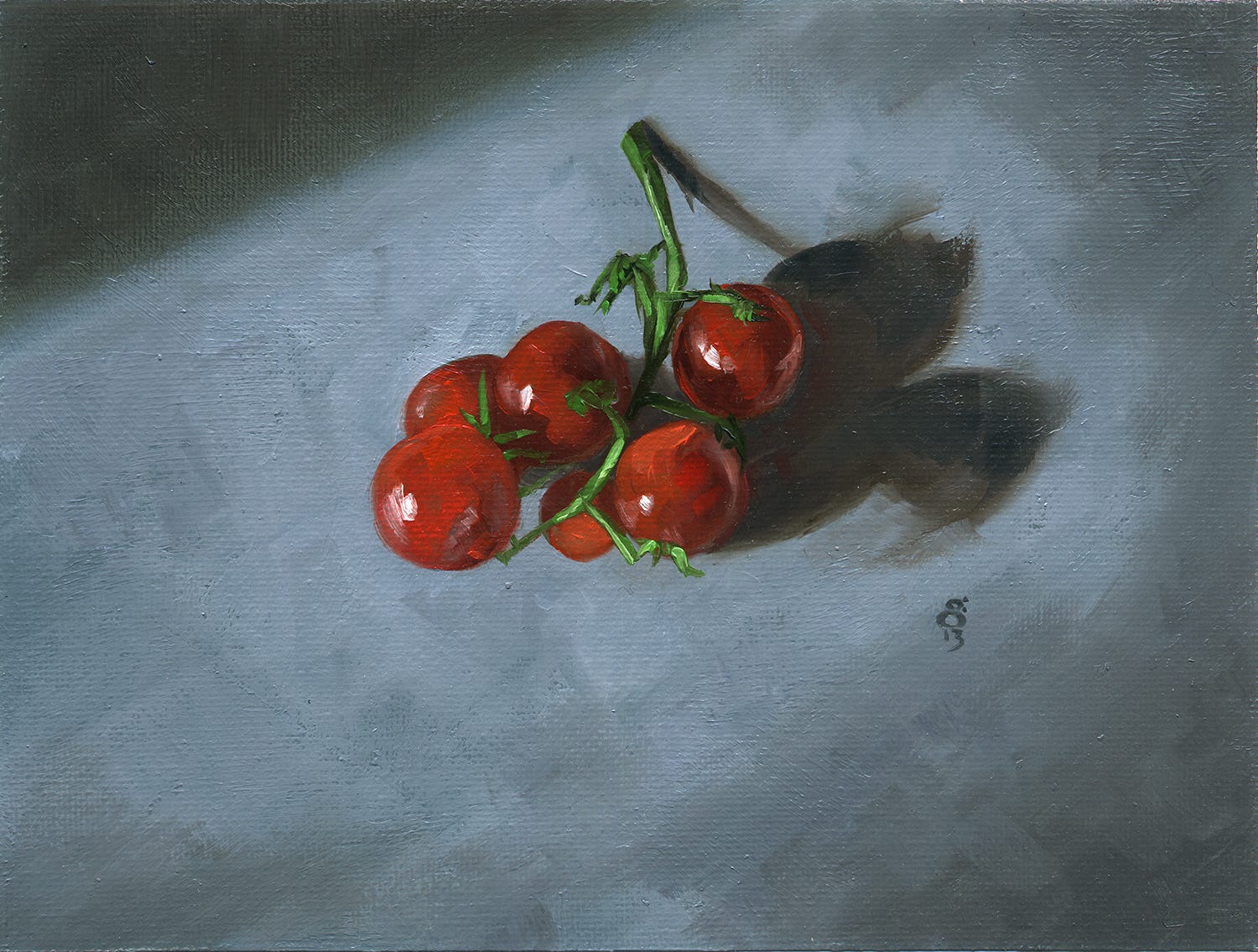
It’s interesting looking back at some of these simple experiments, after-hours, with no expectations that I need show them. Here, I had taken a sheet of gray canson paper and taped it to the wall. I used thin sewing needles to tack this bunch of small tomatoes to it, and then played a bit with lighting. Then I painted it, trying to make them actual-sized on the canvas.
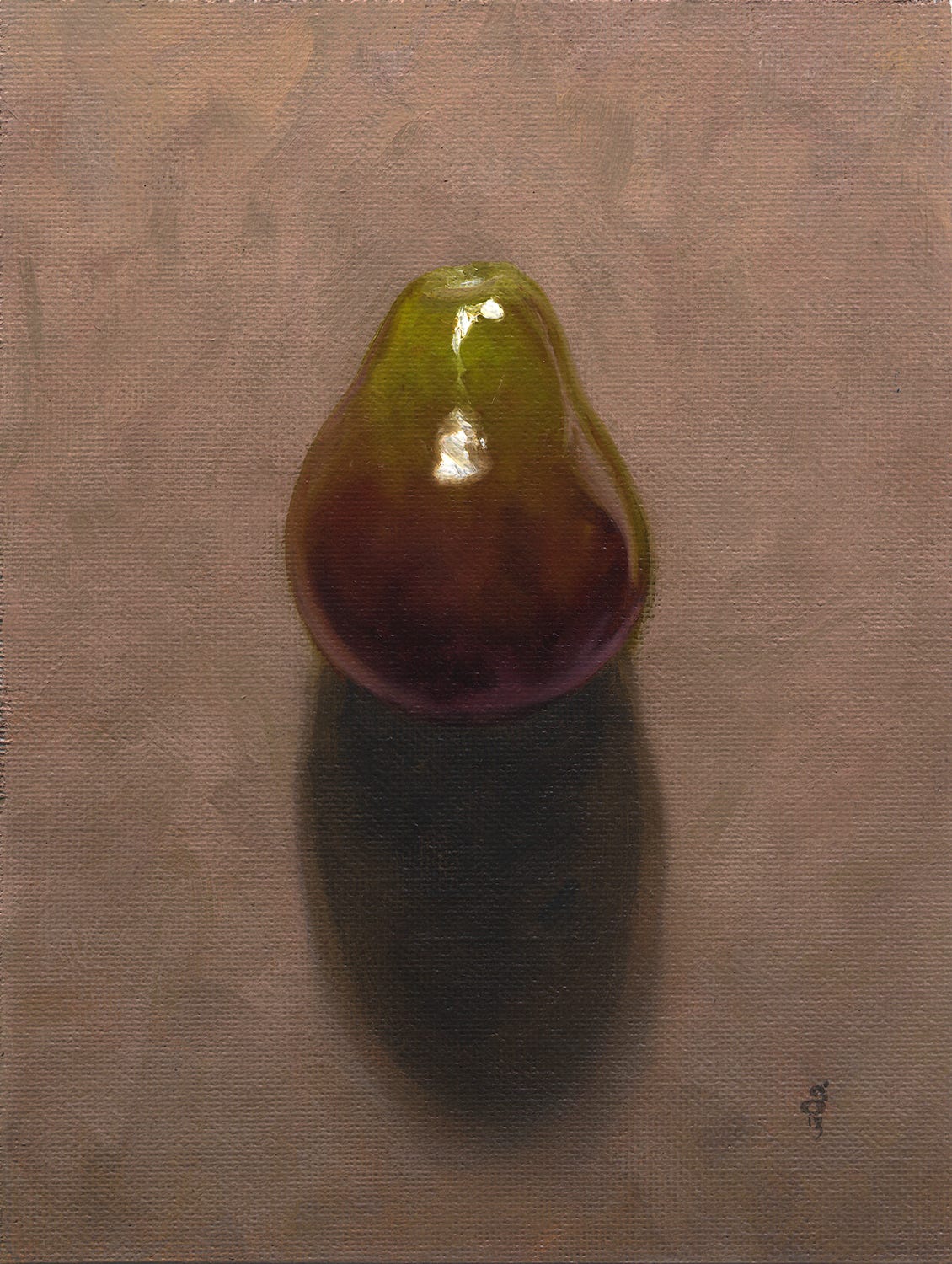
I did similar with the Truffle Tomato, which is a rather simple object to draw, certainly. I was more interested in the color gradation it had. In both cases, these were also opportunities to loosen up a bit with my brush strokes, which I hadn’t done much for quite awhile. As well, they were just one-sitting paintings done with no pre-drawing, something else I hadn’t done much of over the years, since illustrations require sketch phases.
None of this is terribly unique, many artists work this way all the time. Here, however, a couple of things were forming for me. First was just getting back to more expressive brush work, and engaging in still life paintings again as a genre, even if these weren’t terribly interesting. As they were enjoyable, they led to an occasional practice that has spawned 35 or additional small still life paintings since.
The on-the-whim way I pinned or mounted these up so they appear like they are floating just kind of happened. It was likely just so I could look at them straight on from my easel, but the paint handling and the floating object conceit became key features of my Hearts for Hardware series, which I began the following year.
As well, the practice of trying to portray these objects at actual size was something I took into the Hardware series, as well.
This all reminds me that sometimes it’s the random things an artist does on the side, outside of the lens of expectation, that can generate the greatest fuel for the future.