

Today’s post is public, so feel free to share it. I hope you’ll consider joining with a paid subscription to see new posts every weekday.
The original painting for Intermediate Chirography is available in the shop.
I’ve discussed previously the difficulties inherent in the Saga illustration format for Magic cards, but to recap: these are thin, tall illustrations that are supposed to portray an in-world artifact or artwork. So if this were a Saga including the cave paintings of Lascaux, I would have to draw people and animals as they appear in those prehistoric renditions. Of course, I think I can draw better than those folks, but let’s be fair: I don’t have to spend my days running down aurochs for food.
But it means I have to adopt a foreign or naive style for the sake of storytelling. So for Secrets of Strixhaven, I was given two Sagas to do.
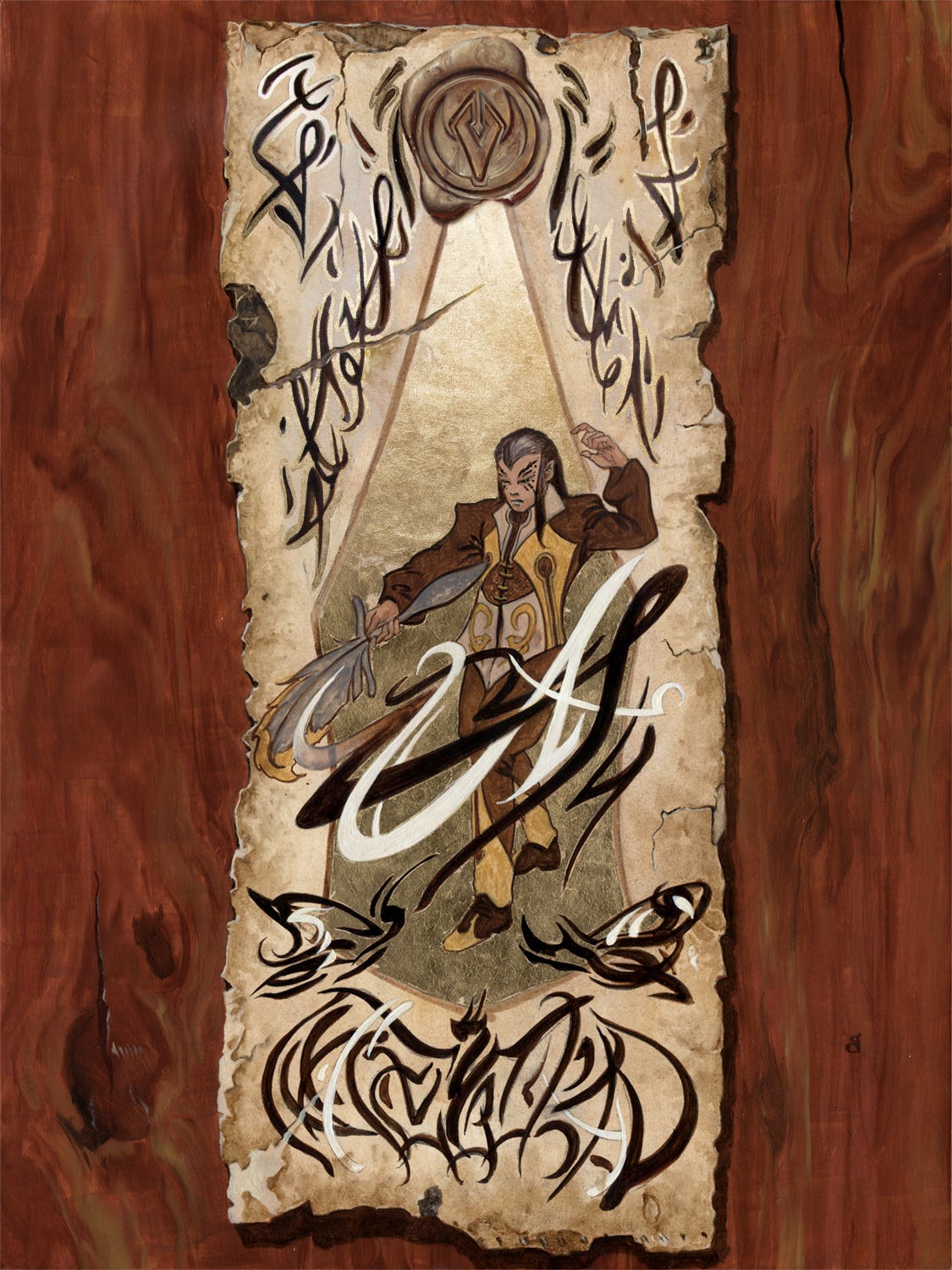
Here, I was to show this Wizard casting spells and creating creatures from the ink-shaped writings of his weapon, which is a giant feathered quill of sorts. Above, inscrutable text perhaps explains the spell or includes instructions for its incantation. Behind the character there is a nib-shaped area of gold leaf, and the tip is punctuated with a wax seal featuring the Silverquill symbol for the College of Eloquence from the set’s world.
There were a couple places I could dig in and have fun more along my own interests, and these were in placing the item on a wood table, and in creating the ancient, weathered parchment.
These I rendered more meticulously in my usual style, adopting a more trompe l’oeil style, which would allow the art on the manuscript to appear even more like art applied to it. In retrospect, given the aging of the parchment, I probably should have taken an eraser to the “ink drawing” on it, to weather and fade it in places more!
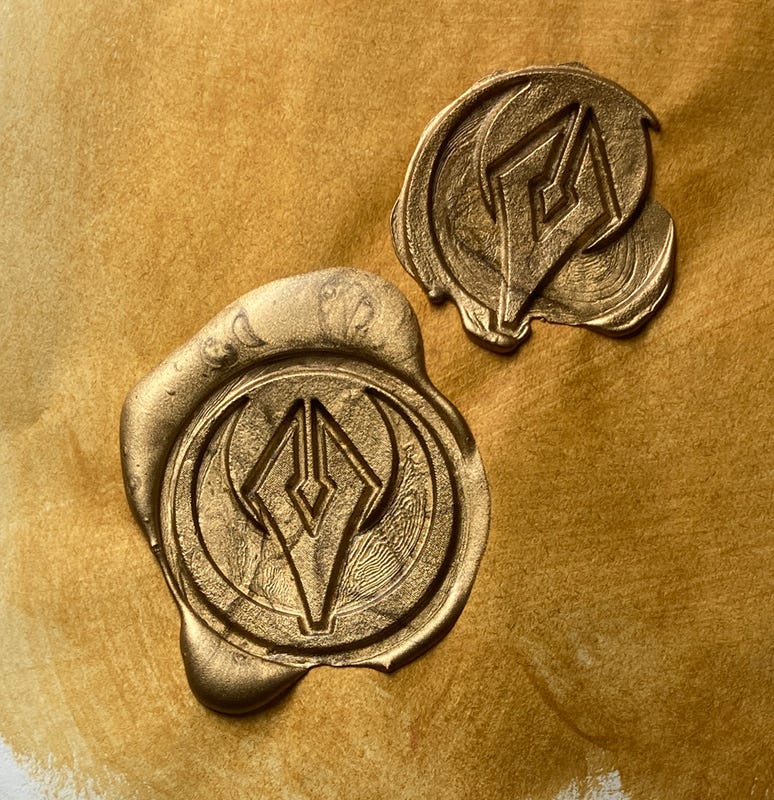
For the wax seal at top, I decided it best to actually reference it rather than create it from my imagination. I printed out the symbol and just ordered a wax seal kit at the size I intended it to be, and pressed a wax seal using iridescent wax. This is now the second time I have ordered a wax seal for use in a Magic card illustration. Can you name the other?
The last challenge was with the genuine gold leaf I applied in the background, and which I used to stroke the calligraphy in the top half. Scanning gold leaf doesn’t look too great since it scans a uniform sheen. In person, the fun of leaf is that it reflects the light differently depending on angle, ambient light, and so on. So here I scanned the painting so the painted portions would look their best, and then shot a hi-resolution photo of the painting so I could adjust the lighting to reflect in the gold area. Then I combined these to make the final scan. But no one scan or photo of the original art is the right way, since it’s always variable in real-life.
I briefly considered actually applying the wax seal straight to the painting, which would create an actual 3d artifact. The issues were that this didn’t leave room for error (you can see an earlier, bad attempt in the photo), and there ran the risk of it cracking of chipping off the painting, or completely delaminating from it! Definitely would not want the latter, though I suppose some cracking or chipping could be considered in-character.
So instead, I simply used the photo as the reference to paint it in oils onto the art.
what is the other magic piece where you ordered a wax seal?