

Rorshach (2008)
C.S.I. Queens
Please enjoy today’s public post. I hope you’ll consider joining with a paid subscription to see new posts every weekday.
When I read the Watchmen graphic novel in 2007, I did not intend to mine it for illustrative purposes. Instead, I read it as a reader--I simply enjoyed it.
Upon finishing it, however, I was struck by the character of Rorschach. I am not alone, of course, he’s basically the star of the book. More precisely, he becomes the most loved character the same way that Han Solo is not the main character in the Star Wars story, but really he’s most people’s favorite.
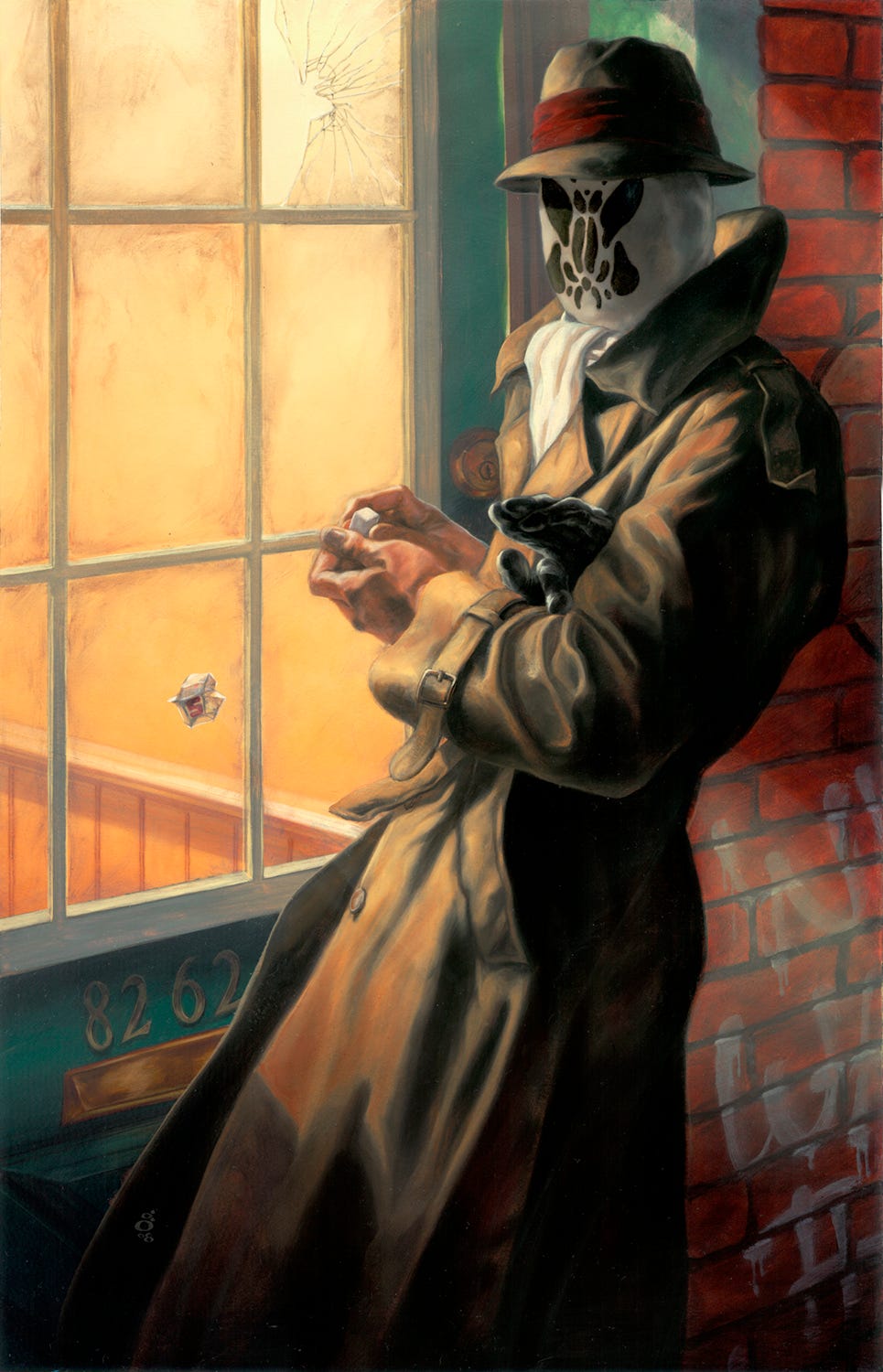
From the start, I was drawn to Rorscach’s genesis story. The story of Kitty Genovese presented in the book immediately took me back to learning about the very story I think in Jr. High School. I didn’t recall her name, it was simply the case of a murder that happened in New York, where there were supposedly lots of witnesses, and no one did a thing. In fact, as the story goes, people watched and did nothing. It shocked my conscience at the time--I think it probably shocked a lot of consciences at the time, which is how the story persisted in popular culture.
In any case, we had just arrived on the East Coast in spring of 2008, when I picked up the Rorschach thread again. I began by reading about the Genovese crime specifically, with an eye to picking up some symbolism to incorporate into the image. I was struck with the belief that the initial news reports were sensationalized some, that the night did not in fact go down as callously as portrayed. Rorschach was transformed by the story, and though the pure facts of the attack remain brutal, the part of humanity’s indifference it seems to me were not as portrayed. Was Kovacs’ transformation, then, based on half-truths? It’s an interesting question.
What immediately struck me, and hadn’t until I began reading about the crime in more detail, was that the crime scene still existed at least at that time--the buildings hadn’t been demolished and rebuilt as so many in NYC are, so constantly. Suddenly I knew what I had to do. We grabbed a camera and took to the subway.…
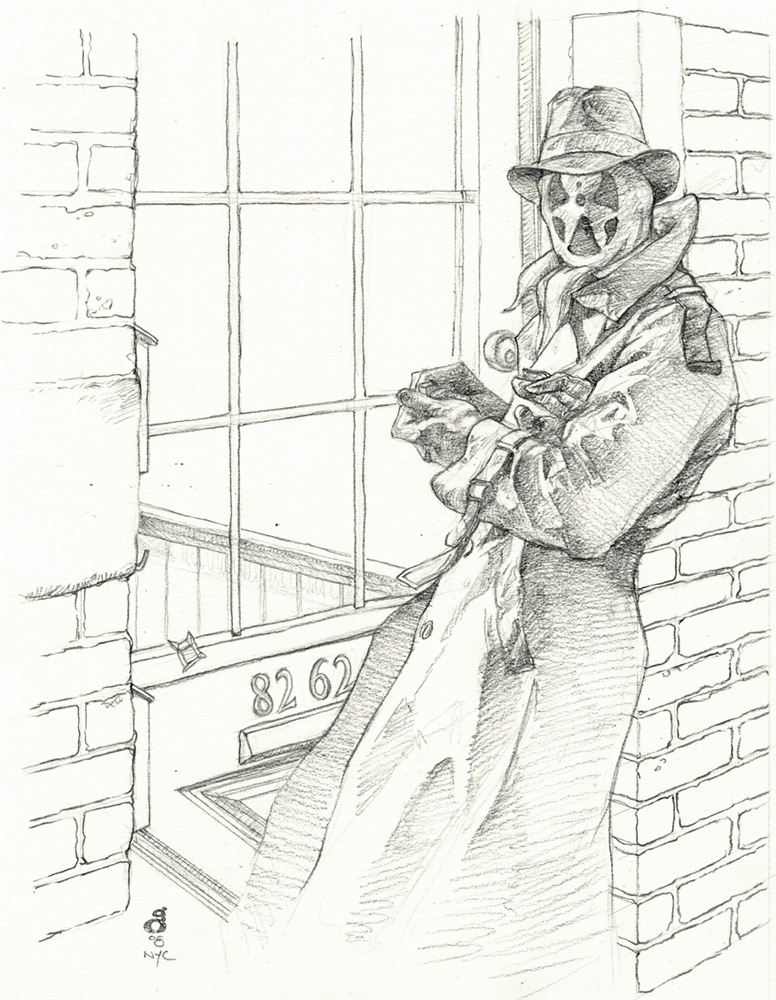
The Genovese crime scene was located in Kew Gardens, a quite pleasant community in eastern Queens. Exiting the subway at the Kew Gardens stop on the E line, you find yourself on a wide busy street, like so many others in the area. We asked for directions to Austin St., where her apartment had been, and headed into a really nice neighborhood with detached homes with yards front-and-back. After a few blocks we got on track and eventually found the charming Tudor-style building on the corner of Austin and Lefferts St. where Kitty lived and died.
I had seen some pictures and had the pertinent address jotted down, but hadn’t taken extensive notes. I walked along the front of the building and took photographs. But I didn’t see any entrances to the apartments above the shops on the bottom floor. I had forgotten or not paid attention to part of what made the story as originally reported doubtful: Kitty’s apartment entrance and the scene of her death were in the rear of the building.
So we walked around to the back of the building, using the same path she staggered around. She then slowly made her way along the mews behind the building, intending most likely to escape to her apartment and lock the door.
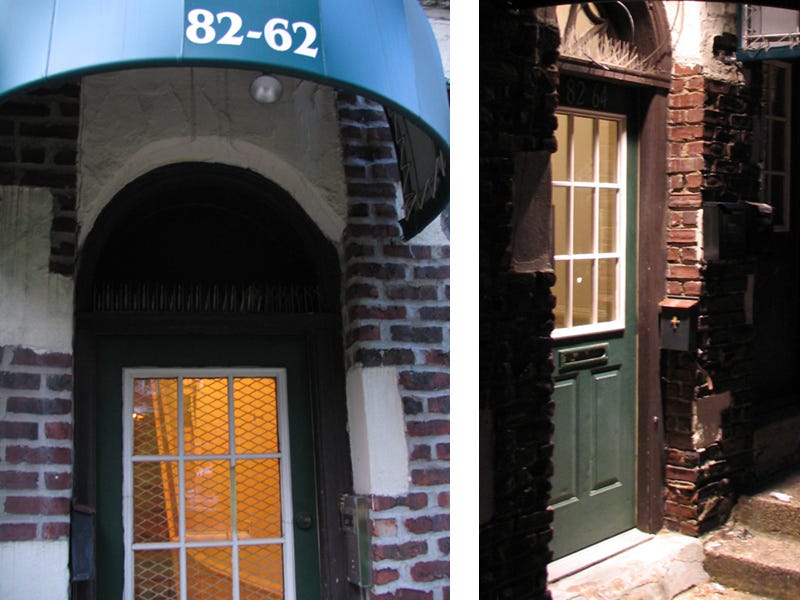
And there they were, the single doorways to the floor of apartments above. There were two doors of note: 82-62 and 82-70. She was attacked again and died just inside the entrance of the former, but lived in the latter a few good feet further down. I wanted the crime scene I portrayed to be the real deal. I took photos of both, because it was evening and wanted to see details. But what interested me most were photos at night, when the crime happened, when Rorschach would be about, perhaps to pay a visit....
We headed back that night after dinner. The first thing that disappointed me was how dark the alley was. Aha--I had been imagining the scene lit with street lamps, since of course so many people had apparently witnessed the nighttime murder and I had assumed this was because it was well-enough lit. I took some photos of the entrances again, and noticed that above the entrance to each door was now mounted a rather modern-looking lamp. Surely they were not there in 1964. I noted that, and realized that if I were going to portray the scene, it would be that much darker. In fact, the only light in the mews at the time would’ve been that which came from the entrance hall behind the doors, and a small lamp that existed at the time that was just about across from her actual apartment door. Not much. The doubts about the original reports were making more and more sense. There are no tall buildings behind the scene for some distance, because the rail lines run right behind the apartments. There were not many places where one could witness the worst of the crime from except for: neighboring windows of other apartments above, and only if you craned your neck out, and a taller building some 100 feet away on the opposite end of the train station parking lot. I snapped more photos, considered all these things and what they might mean for my picture, and left.
In illustration, one is taught repeatedly that when image-making and truth collide--unless you are doing historical illustration---image-making wins. What this means is that facts are disposable and should be disposed of to create a better image. As you look around most fantasy art, you can see that this dictum has been broadly embraced. I agree with it in many situations, actually. In investigating the Genovese crime scene, I was struck by the number of things I was unprepared for. The architecture, the lighting situation, that I could not have Rorschach standing across the street with the building in the more distant background, since there was no street to speak of behind the building--just a few feet of weeds, a fence, and then train tracks. I returned from my trip excited but also with this dilemma: which side of the law written above was I going to come down on?
So what to do--do I delve into a much darker and quieter scene than I intended, and remain true to the backstory, even though the only people who will know my intentions are you, dear readers, and those I relate it to in person? Or do I chuck the truth, create what might be a cooler picture, unconstrained by the facts of the matter, and just focus on the eventual portfolio-goal?
I struggled over it for a long time, but decided that though it might be more noir than comics typically allow, I would stay true to the story, true to the reality I’d discovered, and please myself first. The main reason, even then was knowing I may never finish that portfolio (as ended up the case), and if I did there was no guarantee it’d get me work anyway--in either case, I’d be personally unhappy with a portrayal that ignored the facts.
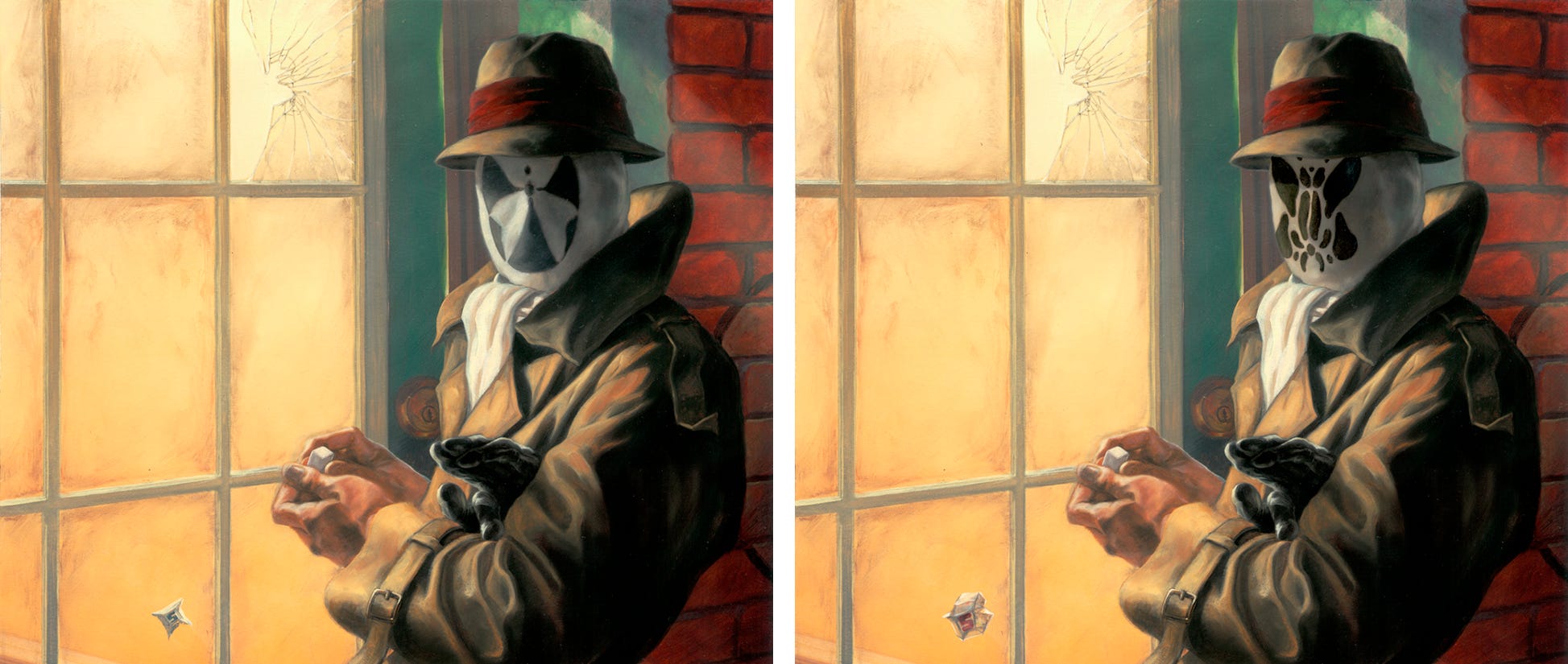
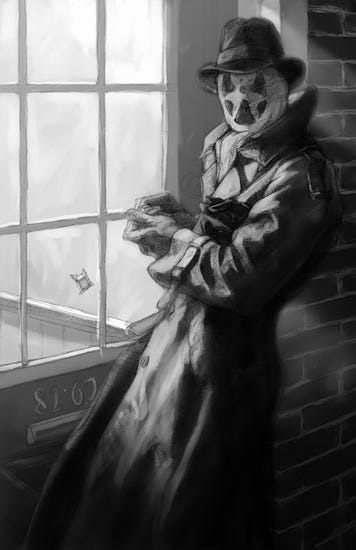
Early on, I looked at Rorschach’s mask and considered that it was basically an open canvas for adding another layer of storytelling. My initial thought was to weave in a bit of the apocalyptic into his facial pattern, and the Cold War era fallout shelter symbol, ubiquitous in NYC, was my early choice. I actually finished the painting this way. Quickly unhappy with that choice, I pulled the painting off the shelf and worked back into it. It’s not often that I rework “finished” paintings. I prefer to learn lessons but apply them forward. This one was fresh enough that it wasn’t much effort to change. As well, because the mask is an isolated shape, it was easier to paint it out.
I still liked the idea of putting something referential into that mask--such a shame to waste that space! So this time I dug back into the book, and used the exact Rorschach blot used when he’s being questioned and lies about what he sees; the “pretty butterflies” pattern. That was a really haunting moment, and it tied everything together again.