

The Imperial Escort (1998)
Transitions
Please enjoy today’s public post. I hope you’ll consider joining with a paid subscription to see new posts every weekday.
In art school you mainly paint in oils. I didn’t take many painting classes, and the ones I did take normally didn’t have instructors who could actually paint, or at least teach one to use paint. Correction, they couldn’t paint in any style relevant to what I was trying to do. So my tendency was to get looser, brushier, and thicker with oil paint, and not in a good way. Somehow my Acrylic work which I did at home between assignments was tighter, mostly.
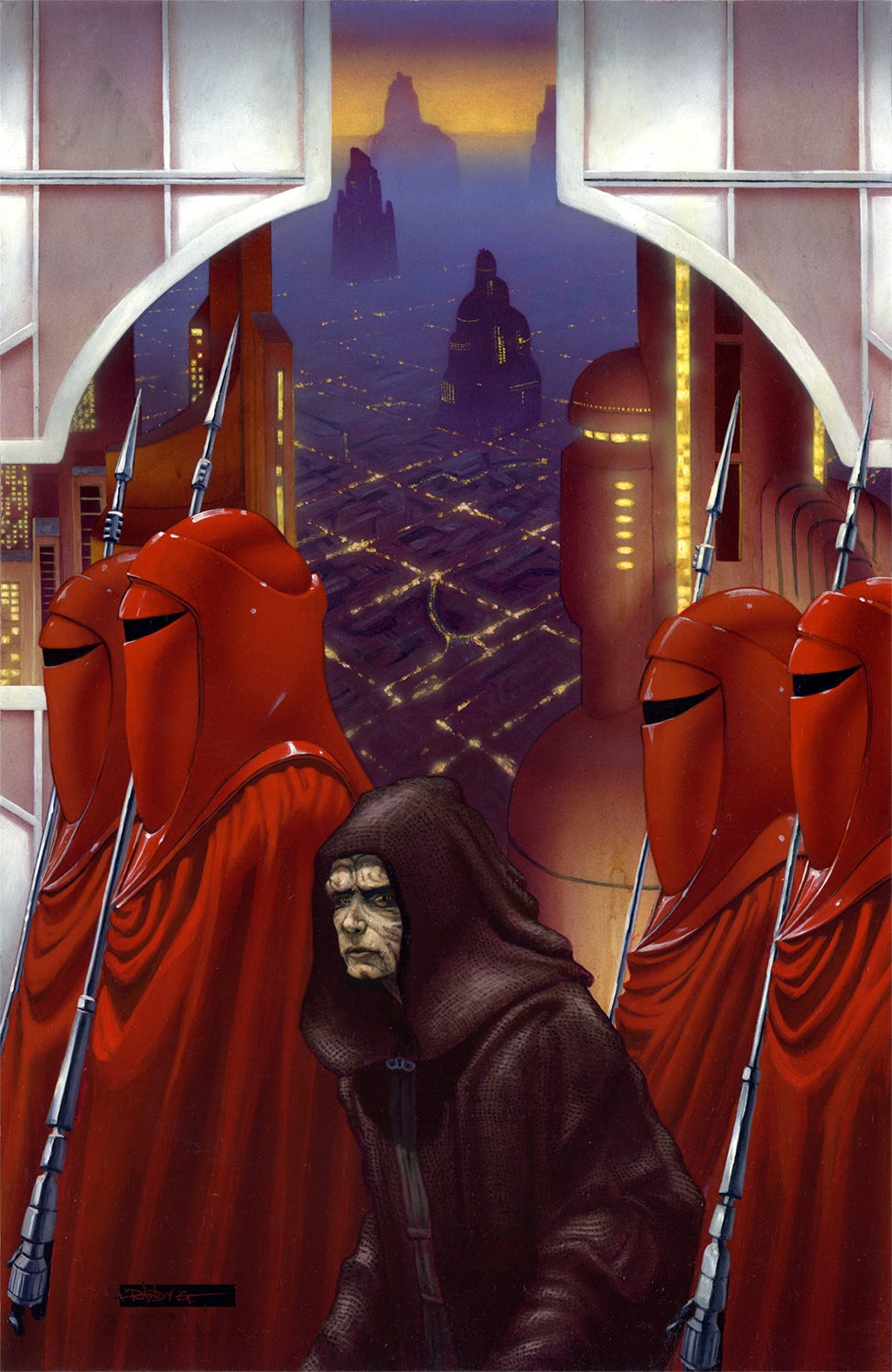
By the time I left art school I had therefore not gained firm discipline to work finely in oils. I didn’t work well loosely with them, either. But my acrylic technique had been more honed. So when illustration work began I just moved right into it with acrylic. Here and there I’d use oils, for no particular reason from what I remember, but they rarely helped matters. Usually, back then, they hurt.
My acrylic technique at the time was a combination of airbrush and layers. I used Golden Soft Gel Medium a LOT. I’d mix a color, usually 3/4 dark for the area I was working on. I’d paint the area, then I’d adjust the color slightly lighter, and slightly more affected by the lightsource. I’d add the Gel Medium to it to make it slightly more transluscent, then I’d paint the same area again. I’d repeat this process, and as the color got lighter, I’d have to paint less of the section each time, because that lightened color was found on just slightly less area than the prior one, until I reached the highlights, which would be touches here and there. In this way I managed to get pretty smooth gradations of color with a nice luminescence due to the layering. It also took forever--longer than it took to describe, even. I’d then airbrush the last 1/4 of the shadow value for most areas, so the shadows were softer than the highlights, which is generally true in nature. Who taught me this tortured process? No one. It sounds a little like the Hildebrandts describe in their book, which I got later, but they laid out their gradations all at once and then grabbed color on the fly. They also didn’t take great pains to blend out the edges between each value step. Nor did they airbrush the shadows.
Somewhere along the way I realized that I was killing myself trying to make my acrylics look like oils. I realized that I should probably just switch to oils. But every time I tried, my undisciplined bad habits took over and the paint would get thicker, and less refined. Some of it turned out alright, but often it wasn’t working. So I’d run back to my acrylics.
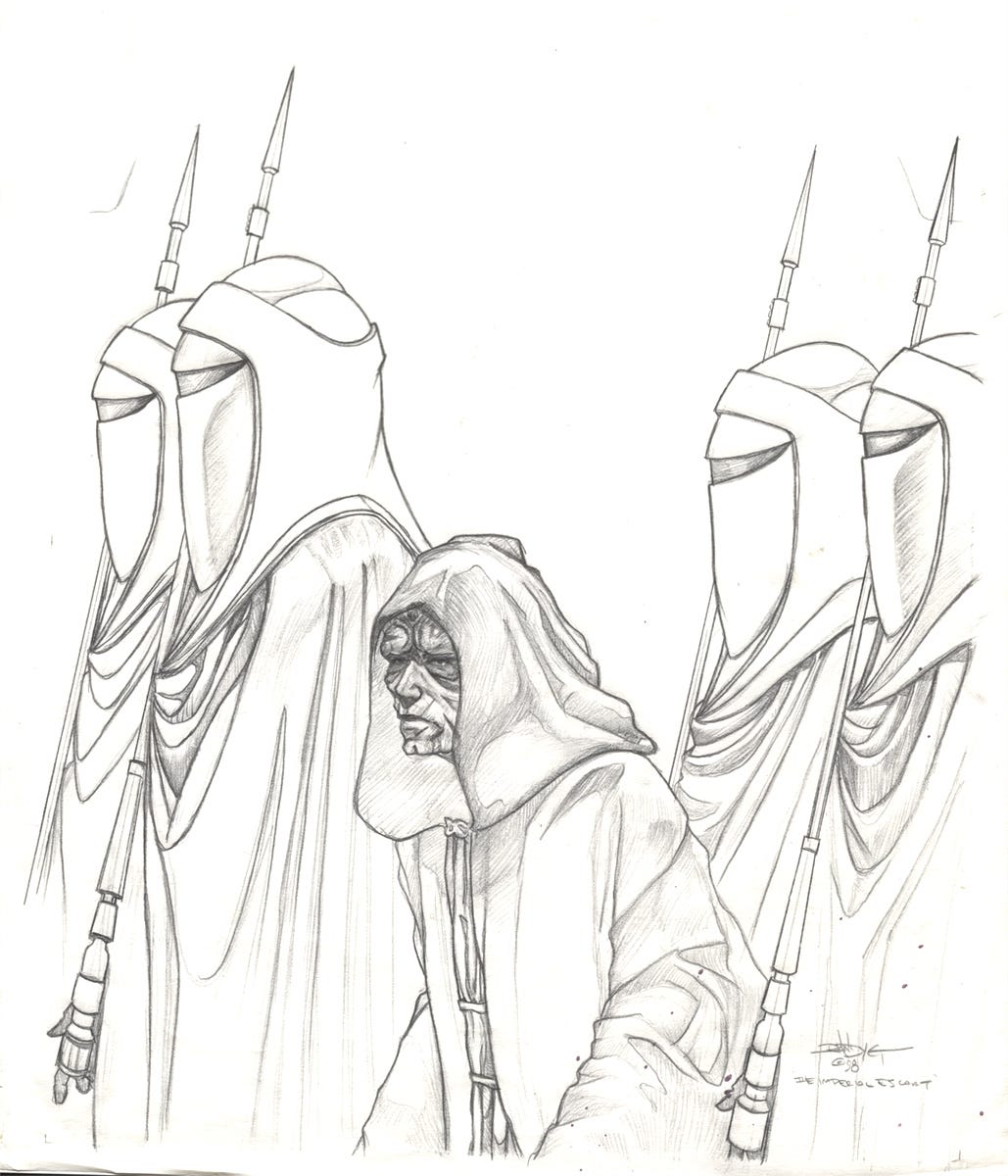
I got married in 1998. Before I left for my honeymoon I did a Star Wars-related portfolio piece, shown here, primarily in acrylic, with a little oil thrown in. When I returned from my honeymoon I did a second one, in oils this time for no reason except that finishing the prior one in oils was fun, and helped. For the first time, I really felt that the oils had gelled, and I produced a piece that had the discipline I’d always wanted. There was no turning back--it was a huge improvement on what I’d been doing, and I sought after it full-bore.