

The Spider Who Saved Christmas (2020)
A New York Times Bestseller!
Please enjoy today’s public post. I hope you’ll consider joining with a paid subscription to see new posts every weekday.
Authored by Raymond Arroyo, The Spider Who Saved Christmas is Raymond’s fleshing out and retelling of an older folktale / legend, which seeks to explain why we hang tinsel on our Christmas trees.
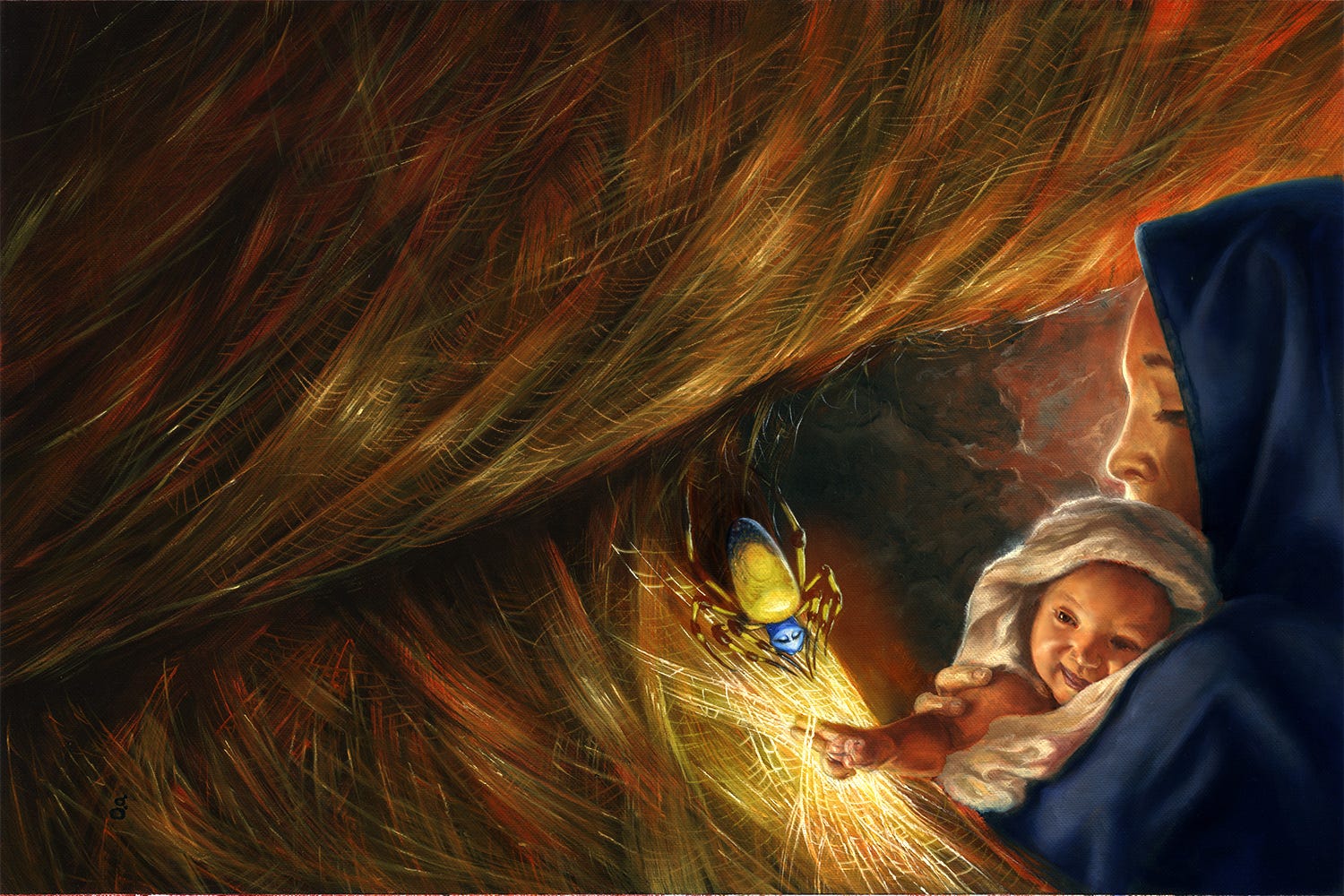
I had not heard this tale before, so I read it as just a pleasant new legend. I was contacted by Sophia Institute to illustrate this children’s story, and I spent a good chunk of the initial COVID-lockdown working on it—an enjoyable distraction, considering all the stresses outside my home.
The book contains 17 2-page spreads, which I illustrated. The art is printed edge-to-edge, with text overlaying it, designed by Carolyn McKinney, whose work and collaboration really elevated this project.
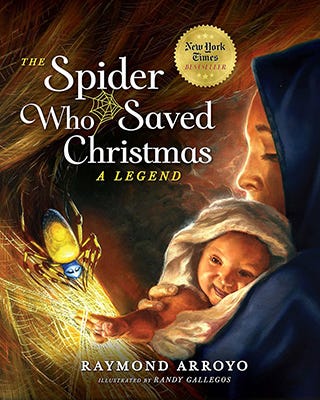
It was a very different project for me. I have done a few illustrated stories like this in the past, but they were always books where the illustrations did not integrate with the text, which was usually printed around illustrations, or on opposite pages.
As well, the scope of the project was larger than prior illustrated stories. I’ve gotten used to illustrating in single-shots. Clearly, my work on Magic: the Gathering appears as standalone illustrations that don’t integrate with text, and other book cover work I’ve done has simpler cover design that just takes up the top third or half. So there was a lot of stretching here, between the scope, collaboration, and thinking about threading a narrative across multiple illustrations.
Between Raymond, Carolyn and myself, there was definitely no lack of blood, sweat, and tears in making this story come to life. It was one of the hardest projects I’ve ever done, after about a month of back-and-forthing to get to the starting line, my records tell me that I produced all the art from nothing over about 55 days. I started sketching for the book in late June. I had all 17 spreads and a spot illustration done, including tweaks on finals, by August 17. 17 spreads, plus one that was put aside and re-done, and some decorative borders for the back cover.
I’d say I don’t know how I did it, but I did it again the following year. It hurt, a lot. I’m still going to say I’m not sure how I did it.
In the end, however, the book made the New York Times Bestseller’s list, which was a nice surprise, and remains in print.
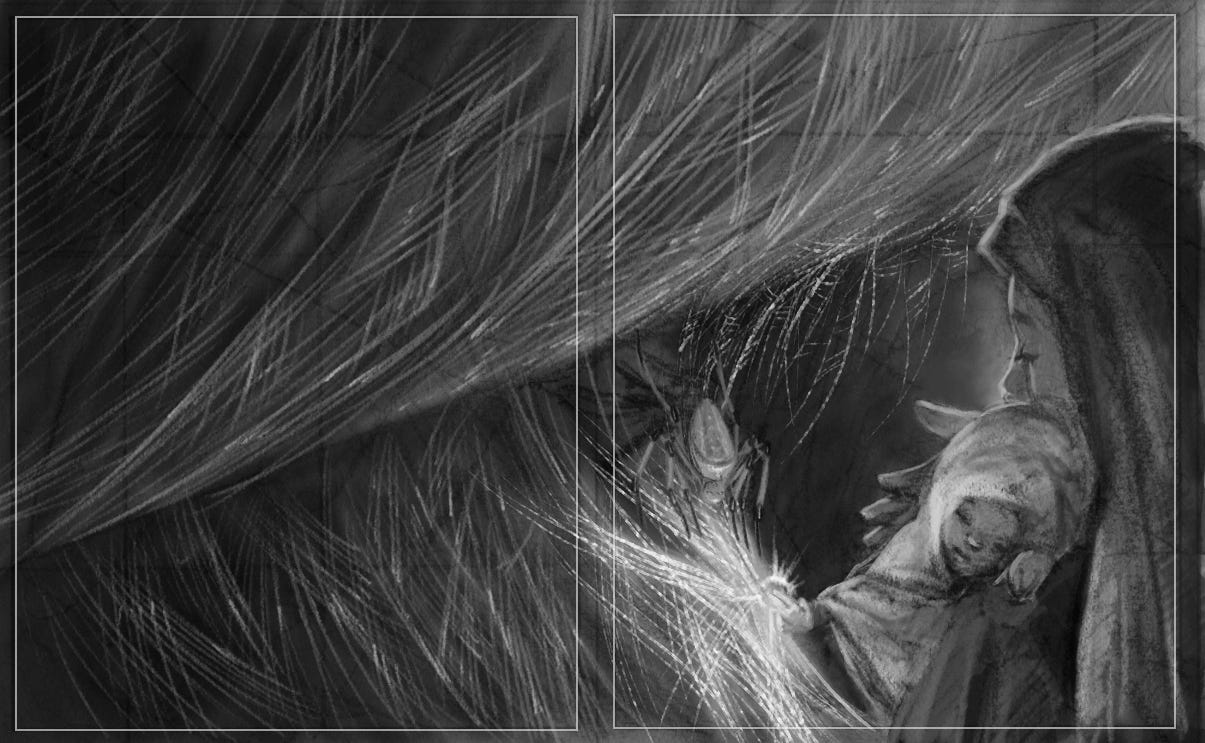
The first piece I was asked to finish was the cover spread, which was a full painted piece along the lines of most of my work. Owing to the incredibly tight schedule, I opted to paint the rest of the book differently, which I’ll get to. So this piece took longer than 3 days owing to the larger size and full-color approach.
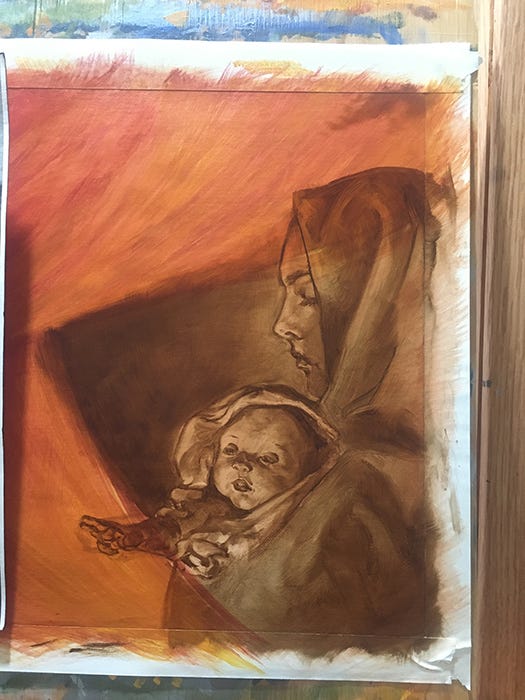
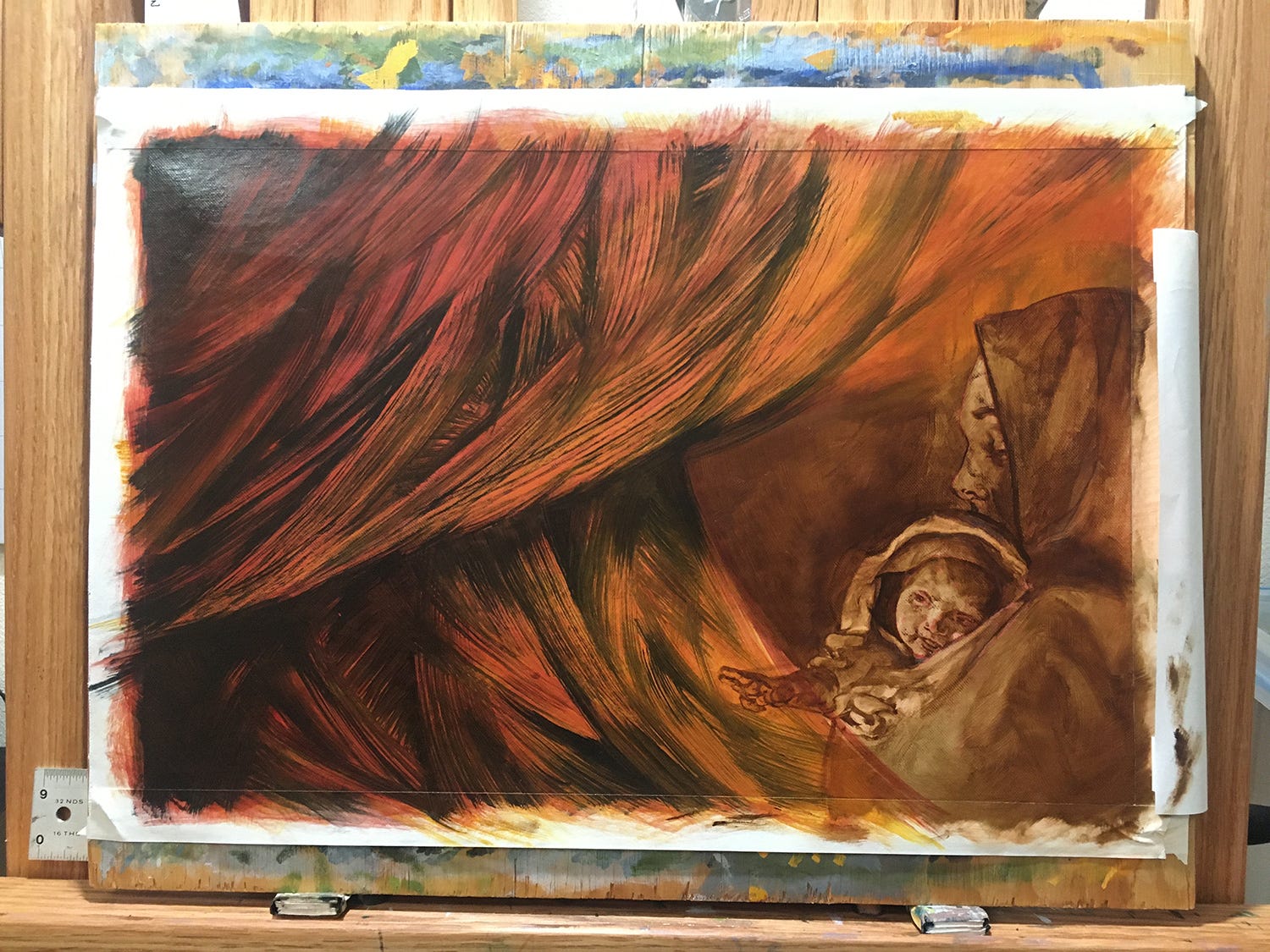
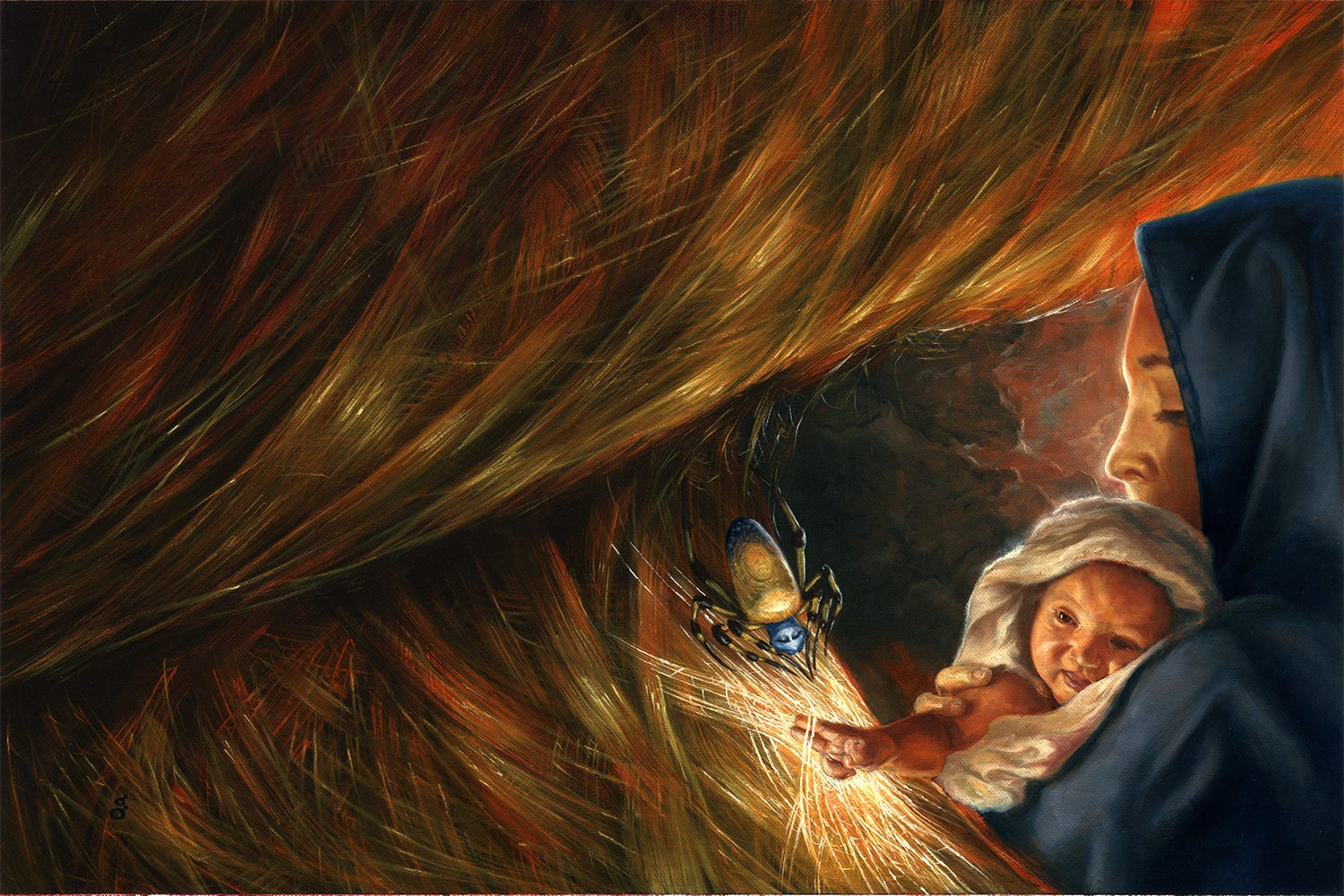
The painting features a thick “curtain” of golden web produced by the spider Nephilia. It has been pulled aside here as Mary exits a cave, hinted at by the daylight rimlighting of the exit behind her and off-camera.
Not long after, while I was cranking away at the interiors, the cover design got put together and some minor tweaks were requested, viewable in the first image here. Mary’s robe was more saturated, the glow on the web increased and some minor figurative details adjusted.
*Full-bleed: when artwork is printed beyond the edge of an item so that the art is seen fully edge-to-edge, with no border.
*Trim: to achieve full-bleed, some of the art must fall beyond the templated trim of the sheet, so that when the sheet is cut to Trim size, the art then runs edge-to-edge. Because machine cutting is not exact from sheet to sheet, the bleed usually runs an extra amount beyond the page in accordance with printer’s specifications.